
AI moderation vs human moderation
A decision guide for trust and safety leads choosing between fully automated, fully human, and hybrid moderation — compared on speed, accuracy, cost, edge cases, and legal liability.
Published 2026-05-27

TL;DR. AI moderation is roughly 100x faster and 50-100x cheaper per image than human moderation, but weaker on contextual edge cases and harder to defend under the EU Digital Services Act and UK Online Safety Act when used alone. Human moderation is accurate on context but does not scale to a public platform. The right answer for almost every regulated user-to-user service is hybrid: an API like Pixicular's image analysis API scores every upload and a small human team handles the 1-5% borderline queue.
What does AI-only moderation actually do?
An AI-only moderation pipeline is a vision model behind a REST endpoint plus a thin policy layer in your backend. When a user submits an image, your service forwards it to a moderation API, the API returns a confidence score between 0.0 and 1.0 for each category in its taxonomy — nudity, sexual activity, suggestive, violence, drugs, weapons, and so on — and your code compares each score against a configured threshold to produce a verdict. No human ever looks at the image unless the user appeals.
The strengths are throughput and consistency. A single moderation API call takes a few hundred milliseconds, which means moderation can run synchronously inside the upload flow without users noticing a hang. The same model applies the same scoring to every image, so a policy decision today and an identical case six months from now produce the same outcome. That repeatability is what makes automated detection useful as the bulk-volume layer of any moderation pipeline.
The weaknesses are context and novelty. Vision models are trained on a labelled distribution, and any image outside that distribution — reclaimed iconography, satirical or news-context use of otherwise-prohibited imagery, niche cultural symbols, or content the model has simply never seen — is where the confidence scores get unreliable. A pure AI deployment also has no built-in path for users to challenge an automated decision, which is a problem under the appeals duties in the DSA and OSA.
What does human-only moderation actually do?
A human-only moderation pipeline routes every user upload to a trained reviewer. The reviewer opens the image, compares it to the platform's written policy, and makes a yes/no/escalate call. Most platforms with a human-only model pair it with a ticketing system that records every decision, a quality program that re-reviews a sample of decisions for consistency, and a wellness program for reviewers who handle graphic material.
The strengths are context and accountability. A reviewer can take into account who uploaded the image, the surrounding text, the platform's policy intent, and the platform's history with similar content. Every decision has a name attached to it, which matters when a regulator, a press query, or a court asks why a particular image was kept or removed. Edge cases — satire, news-context graphic imagery, culturally specific symbols — are where a trained reviewer is dramatically better than any classifier.
The weaknesses are throughput, cost, and reviewer welfare. A productive image reviewer handles a few hundred items per hour at most. At a public platform that receives thousands or millions of uploads a day, a human-only pipeline either falls behind the queue, expands headcount linearly with volume, or quietly stops moderating meaningful chunks of the firehose. Reviewer welfare is a serious operational concern: constant exposure to graphic material has documented psychological cost, and a responsible program needs rotation, counselling, and limits on shift exposure.
What is hybrid moderation, and why is it the steady state?
Hybrid moderation pairs the automated detection layer with a trained human review queue. The API runs on every upload — the same vision model, the same taxonomy, the same scoring — and your backend reads the scores and routes the upload by confidence. High-confidence safe scores auto-approve. High-confidence unsafe scores auto-block. The middle band — usually 1-5% of traffic for a well-tuned taxonomy — goes to a reviewer with the scores already laid out and the relevant policy snippets surfaced alongside the image.
The architecture is the steady state for almost every public platform of meaningful scale because it lets each layer do what it is good at. The API is fast, consistent, and cheap on the bulk distribution. The human handles the contextual cases the model cannot score reliably, owns the appeals path the law requires, and produces the named, recorded decision that holds up under audit. The same reviewer headcount can cover a platform that would be one to two orders of magnitude beyond what they could moderate unaided.
Hybrid is also the architecture both the EU Digital Services Act and the UK Online Safety Act explicitly recognise. Both regimes allow automated tools for proactive detection. Neither permits automated tools as the sole control where a person could be harmed by an incorrect decision. The hybrid pipeline gives you the throughput of automation, the contextual accuracy of a person, and the documented human review path the law expects — in one architecture.
Side-by-side: AI vs human vs hybrid
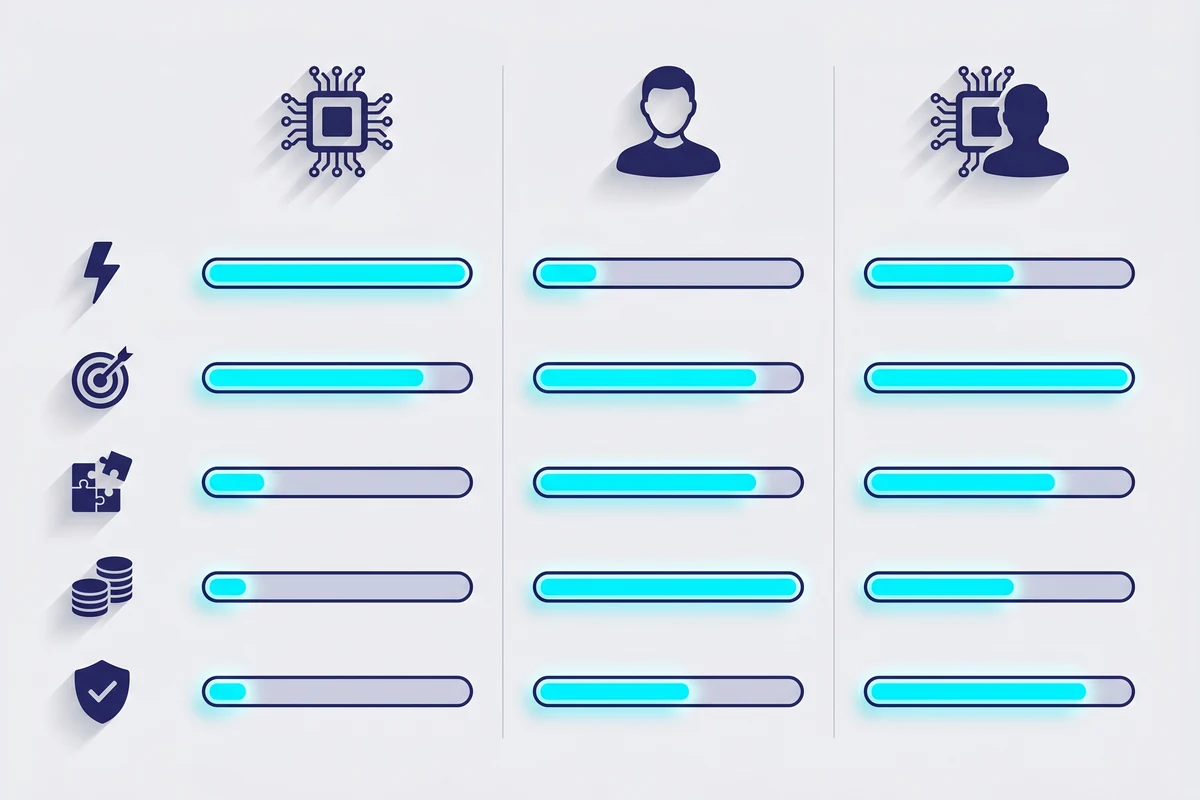
The same five operating dimensions across the three models. Pricing figures are illustrative ranges only and depend heavily on vendor choice, volume, labour market, and the depth of the quality program — treat them as orders of magnitude, not quotes.
| Dimension | AI only | Human only | Hybrid |
|---|---|---|---|
| Speed per image | ~300 ms end-to-end; synchronous at upload time. | Minutes to hours per image, depending on queue depth and reviewer specialisation. | ~300 ms for the 95-99% the API decides; the borderline queue takes minutes to hours. |
| Accuracy on common cases | High. Trained on labelled examples of the standard taxonomy — nudity, violence, drugs, weapons, hate symbols. | High on individual decisions, but reviewer fatigue and inter-rater disagreement drift over a long shift. | High. Model handles the standard distribution; humans handle the cases that need context. |
| Accuracy on edge cases | Weak. Out-of-distribution content, satire, reclaimed iconography, and cultural context are hard for a vision model. | Strong. A trained reviewer brings platform context, policy intent, and prior incidents to the call. | Strong. The model flags borderline scores; the human applies context to those specific cases. |
| Cost per 1,000 images | Roughly $1-$5 in API spend, depending on vendor and volume (illustrative range). | Roughly $100-$500 in fully-loaded reviewer time and tooling, with significant variance by labour market. | Roughly $5-$25: API on every upload plus reviewer time on the 1-5% borderline queue. |
| Scales to a million uploads/day | Yes — capacity is a function of the vendor's infrastructure, not your headcount. | No, not economically. Linear headcount growth and reviewer welfare make it impractical at scale. | Yes — the API takes the bulk and headcount tracks the small borderline queue. |
| DSA / OSA legal liability | Risky alone. No documented human appeals path; opaque decisions are harder to defend. | Defensible in principle, but most platforms cannot resource it at the volume regulators expect. | Defensible. Automated detection plus a documented human review path is the architecture regulators recognise. |
A decision tree: which model fits your platform?
Four questions to land on the right operating model. The exit nodes are the four practical configurations a platform actually deploys.

- 1. Are user uploads in scope at all? If your platform does not accept user-uploaded images, you may still want moderation on third-party content you syndicate, but you do not need a public-scale moderation pipeline.
- 2. Are you in scope of the DSA, OSA, or a sectoral regulator? Almost every user-to-user service serving EU or UK users is in scope. Sectoral rules (financial services, child-safety codes, age-restricted content) add their own requirements on top.
- 3. What is the upload volume? Below a few thousand uploads per day, a small human team can cover everything if the audience is closed and the stakes are low. Above that volume, an automated detection layer is the only realistic way to stay current.
- 4. Is the audience open or closed? A closed, vetted community (employee tool, paid subscriber base, members-only forum) lowers the abuse profile substantially. An open public sign-up is the highest-risk audience.
Three of the four leaf outcomes on the tree are hybrid. The fourth — human-only — is acceptable only for closed, low-volume audiences where reviewers can cover every upload and the absence of an automated layer is not an audit problem. AI-only is not a recommended leaf outcome for any user-facing public platform; it shows up only in genuinely internal use cases where a false approve causes no human harm.
Recommendation for regulated platforms
If your platform is in scope of the EU Digital Services Act, the UK Online Safety Act, a sectoral regulator (financial services, age-restricted content, child-safety codes), or a customer contract that requires documented content controls, the recommendation is unambiguous: run a hybrid pipeline. Use an automated detection API as the pre-publish gate on every upload. Use a trained human review team for the borderline queue, appeals, and trusted-flagger notices. Store the API scores alongside the human verdict and the human reviewer's ID so the full decision chain is auditable.
The same architecture is the right answer outside the regulated case too, just for different reasons. Below the regulatory threshold, hybrid wins on operating cost: a human-only team for a public platform is roughly 10-100x more expensive than the hybrid alternative at the same coverage, and the cost gap widens with volume. Above the regulatory threshold, hybrid is what regulators expect to see when they ask how you moderate.
For a longer treatment of the regulatory side, see the guide on what image content moderation actually is, which covers the DSA, OSA, and CSAM-specific obligations in more detail. For the applied version of the hybrid pipeline at a public social platform, see the guide on UGC image moderation for social platforms.
This page is general information, not legal advice. Confirm the specific obligations for your service, jurisdiction, and user base with qualified counsel.
Code: the hybrid pipeline in two pieces
The detection step is one multipart POST that scores moderation categories and surfaces object labels in the same response. The routing step is plain backend code that turns the scored output into one of three verdicts.
Step 1 — score the image
# Score one image for moderation flags + label cross-check
# in a single request. The hybrid pipeline reads the scored output
# and routes the upload to auto-approve, queue, or auto-block.
curl -X POST https://api.pixicular.com/v1/detect \
  -H "Authorization: Bearer $PIXICULAR_API_KEY" \
  -F "image=@./user-upload.jpg" \
  -F "services=detect-moderation,detect-labels"
See the API documentation for the full request and response schema. Pixicular bundles moderation, label detection, OCR, age estimation, and face emotion detection behind one endpoint, so a hybrid pipeline that also wants OCR or age estimation does not need a second round-trip.
Step 2 — route by confidence
// Hybrid policy: API scores, your backend routes.
//   high confidence  -> auto-decide (the bulk of traffic)
//   middle band      -> queue for a human reviewer
//   low confidence   -> auto-approve

type Verdict = "approve" | "block" | "review";

function route(scores: Record<string, number>): Verdict {
  const max = Math.max(...Object.values(scores));
  if (max >= 0.9) return "block";
  if (max <= 0.2) return "approve";
  return "review";
}
The thresholds are policy you own. A children's gaming community, a dating app, and a medical-imaging archive consume the same scored output but draw the thresholds in very different places. Start conservative on the auto-block side during integration, widen as you watch the reviewer queue.
How an API like Pixicular reduces the burden on human reviewers
The headline figure is the share of traffic a reviewer never has to look at. With a moderation API in front of the human queue, the obvious safe majority — typically 90-98% of uploads on a well-policed platform — is auto-approved and never enters the reviewer's field of view. The obvious unsafe minority is auto-blocked at the same gate. What reaches a person is the borderline 1-5%: cases where the model is genuinely uncertain and where human context is genuinely the right tool.
The second-order effects are at least as important. Reviewer welfare is materially better when the queue is pre-filtered for borderline cases rather than dominated by shock content the API would have caught. Quality programs are easier to run because every reviewer decision arrives with the scored evidence pre-attached, so re-review and inter-rater calibration is faster. Audit response is faster too: the API score, the policy threshold, the human reviewer's ID, and the timestamp form a complete, queryable record of how each decision was made.
Pixicular bundles the moderation layer with adjacent live services — age detection, label detection, OCR (text extraction), and face emotion detection — so a hybrid pipeline that also needs to flag likely-underage uploads, surface prohibited objects, extract text overlay from screenshots, or read emotion in face shots can do it without extra round-trips. See the pricing page for per-plan AI-operation allowances and the API documentation for the full request and response schema.
Frequently asked questions
When should you use AI instead of human content moderation?
Use AI moderation for the bulk-volume layer of the pipeline: every upload is scored synchronously at the API in a few hundred milliseconds so the obvious safe majority is auto-approved and the obvious unsafe minority is auto-blocked. Use humans only for the borderline middle the model flags as uncertain, for appeals, and for novel content the model has not seen. Pure AI moderation without a human path is risky under the EU Digital Services Act and the UK Online Safety Act, both of which expect a complaints handling system. Pure human moderation does not scale to a public platform — even a 100-image-per-hour throughput per reviewer is an order of magnitude slower than a modern moderation API.
What is hybrid content moderation?
Hybrid content moderation pairs an automated detection layer with a trained human review queue. The API scores every upload across categories like nudity, violence, weapons, and drug use, and returns a confidence per category. Your backend applies thresholds: very high confidence routes to auto-block, very low confidence routes to auto-approve, the middle band routes to a human reviewer. The hybrid model is the operating standard for almost every public user-to-user platform of meaningful scale because it combines the throughput of automation with the contextual judgement of a person on the cases that genuinely require it.
Is AI moderation cheaper than human moderation?
Per image, yes — by roughly two orders of magnitude in most pricing scenarios. A moderation API call costs cents or fractions of a cent. A trained human reviewer costs labour-market rates plus tooling, training, quality assurance, and wellness support. The cost story is not the whole story, however: a pure AI deployment that has to compensate for missed edge cases through downstream cleanup, regulator scrutiny, or reputational damage can easily wipe out the per-call saving. Hybrid combines the cheap AI layer for the 95-99% of uploads it handles well with the small human queue for the rest — which lands at roughly an order of magnitude more than AI-only but an order of magnitude less than human-only at the same volume.
Why do regulated platforms need a human in the loop?
Under the EU Digital Services Act and the UK Online Safety Act, user-to-user platforms must run a notice-and-action workflow, an internal complaints handling system, and (for the most serious categories) proactive technology that can detect illegal content. None of those duties is satisfied by an automated classifier alone. Notice-and-action requires a person to be reachable. Complaints handling is an appeals path that, by design, must be reviewable by a human if an automated decision was wrong. Even where the law allows automated decision-making, transparency reports and audit trails expect a documented escalation path. A hybrid pipeline with a moderation API plus a small trained reviewer team is the standard architecture both regimes recognise.
How does an API like Pixicular reduce the load on human reviewers?
An API like Pixicular scores every image against a fixed taxonomy of moderation categories in roughly 300 ms per call and bundles label detection, OCR, age estimation, and face emotion detection into the same request when needed. The scored output lets your backend auto-approve the obvious safe majority and auto-block the obvious unsafe minority, leaving only the borderline 1-5% for a human to look at. The human queue is also pre-sorted by confidence and category, so reviewers spend their time on context-heavy decisions rather than scrolling through low-effort spam. The net effect is that the same human team can cover a platform that is one to two orders of magnitude larger than it could moderate unaided.
Put the hybrid pipeline behind one API call
The quickest way to evaluate Pixicular as the detection layer of a hybrid moderation pipeline is to point a request at /v1/detect with a real upload from your platform. Pick a plan on the pricing page and follow the API documentation for authentication and the full response schema for detect-moderation, detect-labels, detect-age, detect-text, and detect-face-emotions.