
Age Verification API for Age-restricted Platforms
A lightweight age-assurance signal from a single photo — one API call, an estimated age range per face as JSON, ready to drop into your gating logic for alcohol, gambling, adult, and other age-restricted services.
Published 2026-05-21

TL;DR. To verify age from a photo with an API, POST the image to Pixicular's image analysis API and request the detect-age service. The endpoint returns an estimated age range and confidence per face as JSON in one call. This is a lightweight age-assurance signal you use to pass clear adults, block clear minors, and escalate borderline cases to full KYC — not a regulated identity check on its own.
What does the age verification API return?
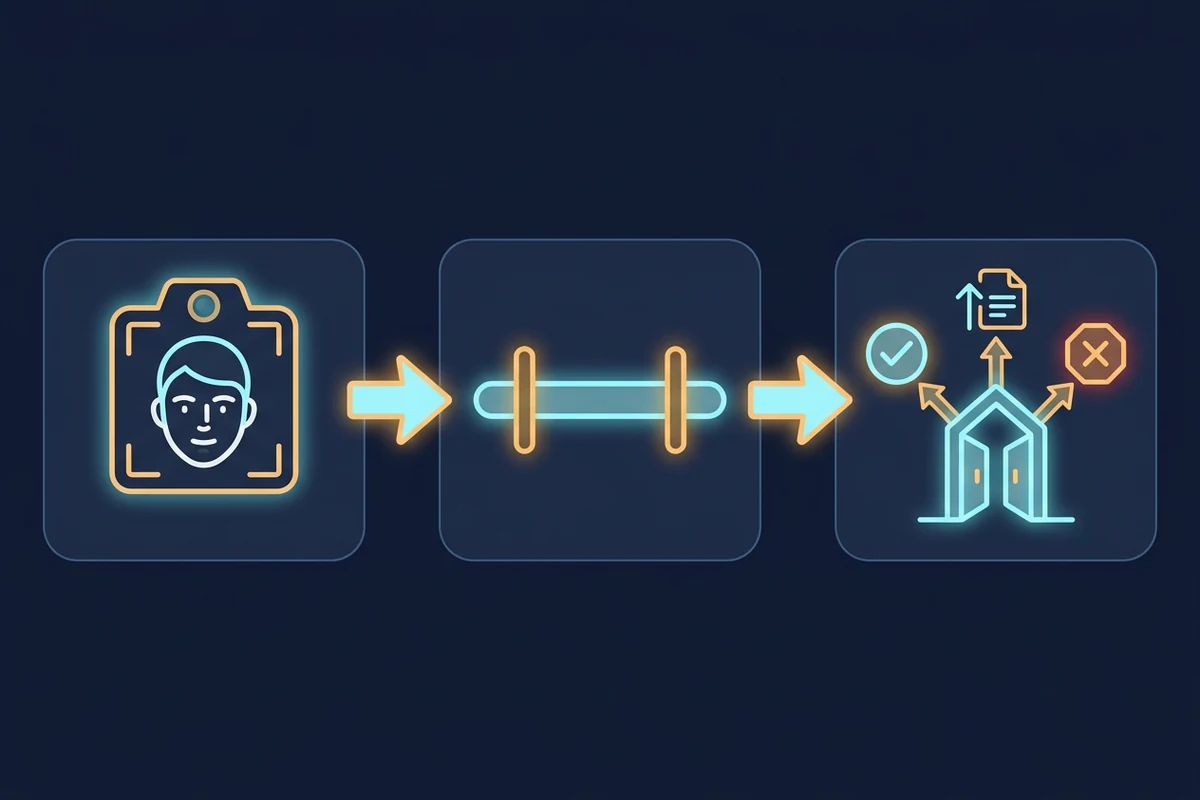
A single POST returns one JSON document with a key per requested service. For detect-age, the value is a list of faces. Each face carries a normalised bounding box, an estimated ageRange with a low and high bound, and a confidence score. Group photos return one entry per face, so you can gate on the youngest detected face when that is what your policy requires.
The API deliberately returns a range rather than a single predicted age. Faces of the same chronological age vary widely, and a band like 19–27is a more honest representation of model certainty than a precise "23". The operational signal is the edge of the band nearest your legal threshold — not the midpoint. The same response can include other services in the same call, such as content moderation, so a single round-trip covers both an age signal and a moderation check on a profile photo.
How accurate is age estimation from a photo?
Estimating age from a single still image is inherently approximate. On clear, well-lit, front-facing photos of a single subject, the predicted range typically lands within a few years of the true age. Accuracy is highest for children and young adults, where growth and ageing cues are strong and well-separated, and lower for middle and older ages, where the visible signal flattens and the natural spread of how people age widens the honest range.
Several factors degrade accuracy: low resolution, motion blur, harsh or low light, extreme head pose, partial occlusion (sunglasses, masks, hair), heavy beautification filters, and faces that are very small in the frame. Treat the output as a probabilistic signal. Near a legal threshold, widen your decision margin: a range that straddles the boundary should be classified as "uncertain" and escalated, not forced into a pass or block on a noisy midpoint. For per-user gating, that escalation path is the difference between an acceptable false-positive rate and a regulatory problem.
For background on how the model works and what the response looks like in isolation, see the dedicated age detection API page.
How does this compare to full KYC age verification?
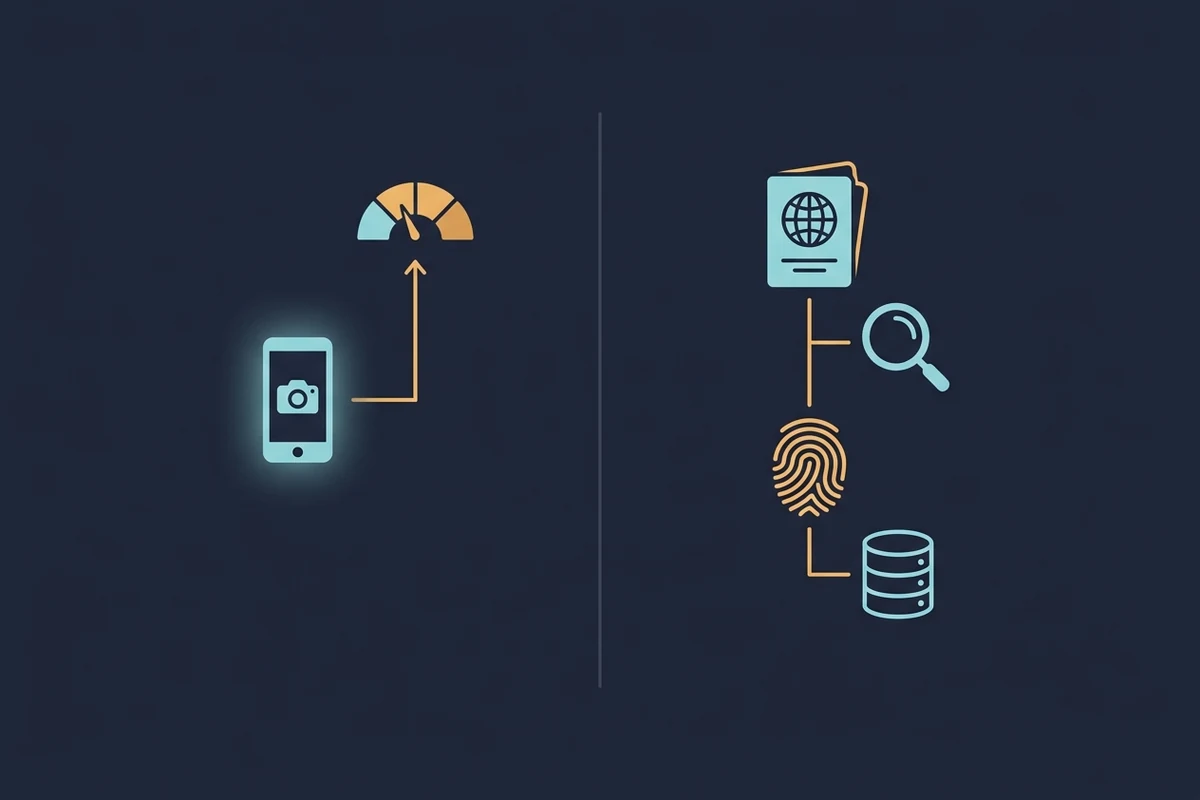
Photo age estimation and document-based KYC sit at opposite ends of an age-assurance spectrum. Estimation is fast, low-friction, and works from a selfie or profile photo — the user is never asked for an ID and the result is a probabilistic range, not a verified date of birth. Document KYC is high-confidence, audit-grade evidence: a passport, driving licence, or national ID is captured, parsed, and cross-checked, often alongside a liveness check. It is slower, more expensive per check, and adds meaningful friction to onboarding.
In practice most regulated platforms run both as a layered stack. Estimation handles the bulk of users — clear adults are passed through, clear minors are blocked — while only the ambiguous ranges are escalated to ID verification. That keeps cost and friction down for the 80–95 percent of legitimate traffic while still putting a strong check on the cases that actually carry regulatory risk. For the document side, see ID document OCR for KYC; this page covers the lightweight first layer.
How do you set a gating threshold near the legal age?
The simplest defensible policy is a three-band decision against the range, not a single cutoff:
- Pass: the lower bound is at least the legal age plus a safety margin (commonly +3 years). Decision-grade for the clear majority of adult users.
- Block: the upper bound is comfortably below the legal age (the margin can be tighter — say -2 years — because letting an obvious minor through is the worst outcome).
- Escalate: everything else, including no face detected, low confidence, and any range that straddles the threshold. Route these to document verification or human review.
Tune the margins for your risk profile. A regulated gambling operator may want a wider margin and a near-zero block tolerance; a vape retailer may accept a tighter pass band because the escalation path is cheap. Whichever you choose, log the decision and the rationale (range, confidence, policy version) — but not the raw image — so audits can reconstruct outcomes without storing biometric data indefinitely.
Where does a lightweight age signal actually fit?
The strongest use cases are flows where you need a quick age screen at the top of the funnel and a stronger check only for the cases that warrant it. A few concrete examples:
| Sector | Typical policy | Where the age signal fits |
|---|---|---|
| Online alcohol retail | Buyer must be 18+ (UK), 21+ (US states) | Pre-checkout age screen; escalate borderline to ID upload at delivery |
| Regulated online gambling | Verified DoB required by licence | Pre-funnel filter to discourage under-age sign-up; full KYC still mandatory |
| Adult content platforms | Age assurance required under UK OSA and several US state laws | First-layer age screen; pair with document or third-party age check |
| Vape, knife, and other restricted retail | Age limits vary by jurisdiction | Reduce friction for clearly-adult buyers; route borderline to ID at PoS |
| Dating and adult social | Platform policy and OSA / DSA child-safety obligations | Flag likely-underage profile photos alongside content moderation |
What do UK OSA and EU DSA require for age assurance?
Two regulatory regimes drive most of the current age-assurance work in Europe. The UK's Online Safety Act (OSA) requires services likely to be accessed by children, and services publishing pornography, to take proportionate steps to prevent under-age access. Ofcom's guidance describes a spectrum of "highly effective" age-assurance measures — including facial age estimation, photo-ID matching, open banking, mobile network operator checks, and credit reference checks — and expects providers to choose methods proportionate to the risk on their service.
The EU's Digital Services Act (DSA) does not specify a single age-verification technique, but Article 28 requires providers of online platforms accessible to minors to put "appropriate and proportionate measures" in place to ensure a high level of privacy, safety and security of minors. For Very Large Online Platforms and Very Large Online Search Engines, the Commission's 2025 guidelines on the protection of minors discuss age assurance — including age verification and age estimation — as part of broader systemic risk mitigation. National authorities and the Commission have iterated on concrete patterns, including an EU age-verification app.
The practical takeaway for engineering teams: a photo age-estimation API like Pixicular is one ingredient in a defence-in-depth age-assurance stack. It is appropriate as the wide first layer that handles the bulk of decisions; for users who fall near a legal threshold, or where regulators expect verified evidence, you still need a stronger method — typically document-based KYC or a trusted third-party age-verification provider. This page is not legal advice; confirm your obligations and the acceptability of any specific method with counsel and the relevant regulator.
Privacy, GDPR, and data minimisation
Estimating age from a face is processing of biometric data under the GDPR and similar regimes, which means a lawful basis, in many cases explicit consent, a clear privacy notice, a data protection impact assessment, and a retention policy that matches purpose. The defensible engineering pattern is data minimisation in three steps: send the photo, read the age range, make the decision — then discard the image. Persist only the decision and a coarse age bucket against the user record. Do not store raw photos or precise predicted ages tied to identifiers for any longer than the audit demands.
For child-directed flows — COPPA in the US (under-13) and the GDPR's age-of-consent provisions for information society services (commonly 16, lowered to as low as 13 by some member states) — estimation is best used as a trigger that routes a likely under-threshold user into a parental-consent or restricted-experience flow, not as a silent block. Confirm the full obligations against the API documentation and your own counsel before deploying age gating in a regulated jurisdiction.
Frequently asked questions
How do you verify age from a photo with an API?
You POST a photo to Pixicular and request the detect-age service. The API locates each face, estimates an age as a low/high range with a confidence score, and returns the result as JSON in a single call. Your application reads the range and applies its own gating policy. This is an age-estimation signal, not a regulated identity check — pair it with document-based KYC where the law requires verified identity.
How accurate is age estimation from a photo?
On clear, well-lit, front-facing photos the estimated range usually lands within a few years of the true age. Accuracy is best for children and young adults and degrades for middle and older ages, low light, blur, occlusion (sunglasses, masks), heavy filters, and very small faces. Because it is probabilistic, design with a safety margin around any legal threshold and treat borderline ranges as uncertain — escalate them to a stronger check rather than gating on a noisy midpoint.
Is photo age estimation GDPR-safe? Is it biometric data?
Estimating age from a face involves processing biometric data under the GDPR and most equivalent regimes. You need a lawful basis, in many cases explicit consent, a data protection impact assessment, transparent notice to users, and a tight retention policy. The defensible pattern is data minimisation: send the photo, read the age range, make the decision, and discard the image. Persist only the decision and a coarse bucket — not the raw photo or an exact predicted age tied to a user.
Can I use this instead of full KYC for age-restricted services?
Not as a drop-in replacement. Pixicular returns an age estimate, which is a useful age-assurance signal but not a verified identity. Where law or licence terms require a verified date of birth — for example regulated gambling, age-controlled retail, or some adult content jurisdictions — you still need ID-document or database verification for the cases that matter. Estimation works best as a first layer that passes clear adults, blocks clear minors, and routes only borderline cases to full KYC, lowering friction and cost.
What gating threshold should I use near the legal age?
Decide against the bound of the range nearest your threshold, not the midpoint, and add a safety margin. A common pattern: pass when the lower bound is at least the legal age plus a margin (for example +3 years), block when the upper bound is comfortably below it, and escalate everything in between to ID verification or human review. Tune the margin to your risk appetite and document it for audit. Always log the decision and the rationale, not the raw image.
Add a lightweight age signal to your gating flow
The fastest way to evaluate Pixicular for age assurance is to point a real request at the API with a real photo. Pick a plan on the pricing page, read the API documentation for authentication and response schema, and pair the signal with ID document OCR for KYC where verified identity is required.